

The Thucydides Trap: a lesson from history that remains highly relevant
“When a rising power threatens to supplant a dominant power, conflict becomes structurally likely.” This idea, developed by the Greek historian Thucydides and formalized 2,500 years later by the political scientist Graham Allison under the name “Thucydides Trap,” is often invoked to explain current geopolitical tensions. Today, it is once again being used to discuss relations between the United States, China, and the rest of the world.

Are you familiar with Thucydides? If not, here is what you need to know. A statesman, strategist, and Athenian historian born around 460 BC, Thucydides is best known for his work History of the Peloponnesian War, which opposed Athens and Sparta between 431 and 404 BC. In it, he analyzes the conflict with a rigor grounded in facts and testimony an approach that elevated history to the status of a rational discipline.
One of his key statements, which alone captures the origin of the conflict, is also worth remembering: “It was the rise of Athens and the fear that this inspired in Sparta that made war inevitable.” Applied to the current situation, it resonates like a prophecy especially if one replaces Athens with China and Sparta with the United States. To the point that today, the question is no longer whether tensions between these countries will intensify, but rather when the rupture will occur.
Trump’s Objective: Contain Beijing Before It Is Too Late
Since 2016, Donald Trump has broken with the consensus that believed China’s economic integration would soften it. His assessment is in fact the opposite: every year lost benefits Beijing. As a result, he has developed a strategy to contain the rise of the Middle Kingdom, based on three main pillars: tariffs, the reshoring of industrial capacity, and energy strangulation.
Tariffs force industrial decoupling. The reshoring of strategic industries (semiconductors, pharmaceuticals, rare earths) rebuilds an American productive base. As for energy strangulation particularly by seeking control over Venezuela and its considerable reserves it aims to weaken a China that remains highly dependent on hydrocarbon imports.
Taiwan, finally, appears as a potential trigger point: the island is home to TSMC, the undisputed giant of semiconductor production. Its reintegration into the fold of the motherland is an objective for Beijing, which represents an existential threat for many actors, starting with Japan, the Philippines, and their neighbors. And what about their American ally?
A Game Board
The current situation is reminiscent of the strategy games of our childhood. What is most striking in the present case is the speed at which the board is being reconfigured. AUKUS, the strengthening of the Quad, and closer ties with the Philippines and India: Washington is methodically consolidating the encirclement of mainland China.
Beijing, for its part, is responding by accelerating the militarization of the South China Sea, strengthening its partnership with Moscow, and developing its nuclear strike capabilities.
As you will have understood, the Thucydides Trap feeds precisely on this dynamic. Each defensive measure taken by one side is perceived as a provocation by the other. The cycle of mistrust becomes self-sustaining, and the vicious circle unfolds.

Iran: Watching What Beijing Does Not Do
In any major geopolitical game, silences are as telling as actions. Since the escalation between Washington and Tehran, China has adopted a calculated restraint: it discreetly purchases sanctioned Iranian oil but refuses to fully commit its political weight.
This passivity is not indifference it is strategy. Beijing is simply not ready yet. One thing is certain: the Iranian issue can be seen as a barometer of China’s strategic maturity. As long as Beijing remains on the sidelines, the message is clear the balance of power is not considered favorable.
But the day this barometer shifts implying explicit diplomatic support for Tehran and visible material assistance the shockwave will be unprecedented. Markets that have not priced in this scenario will likely react with a violence that few actors anticipate. Diplomatic circles would urgently revise their assumptions. Military headquarters, from Washington to Tokyo, would recalibrate their entire threat assessment.
Consequently, watching Iran means watching China not through what it says, but through what it chooses not to do.
Poker vs. Go
Americans play poker: bluffing, sudden escalation, visible and immediate victory. The electoral cycle structurally imposes this short-term temporality.
The Chinese, on the other hand, play go: patience, gradual encirclement, territorial control, long-term thinking. Xi Jinping is thinking about 2049, the centenary of the People’s Republic of China. Within this framework, every tactical concession is acceptable if and only if it preserves the long-term trajectory.
This temporal asymmetry is the most underestimated variable of the conflict. From this perspective, will the United States be able to maintain consistent pressure over five or six successive administrations? Recent history invites skepticism.
Who Will Prevail?
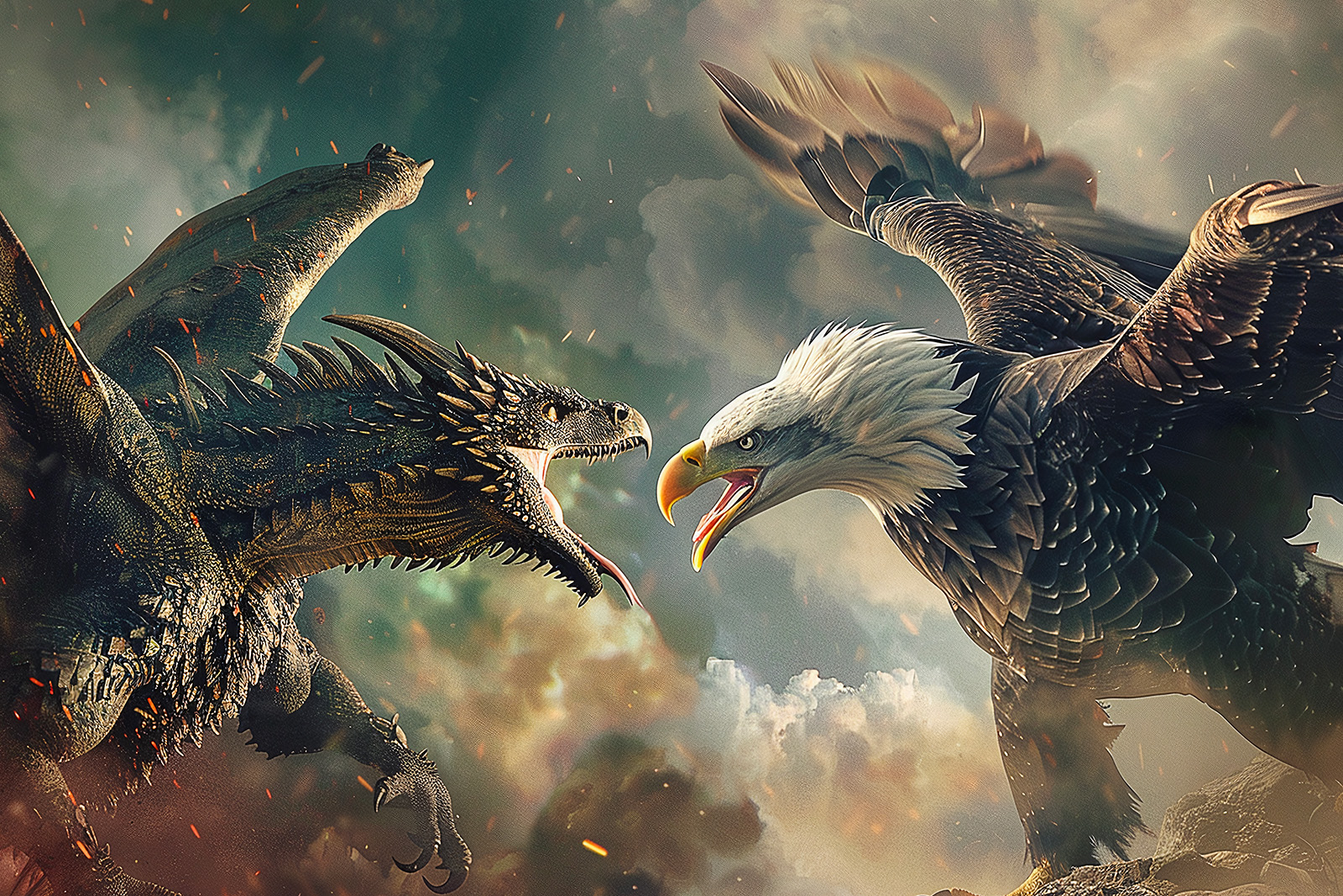
No one knows. What markets are beginning to factor in, however, is the cost of bifurcation. A decoupled world with two distinct economic spheres is structurally more inflationary and more volatile.
For investors, the Thucydides Trap is not just a lesson from history it is a systemic risk variable that must be incorporated into any long-term allocation. From this perspective, the real question may not be who will prevail, but rather what it will cost us.

Tony Pangallo, CFA, CAIA
Partner Senior Financial Advisor
